Numerical Methods For Engineers
Overview & Purpose
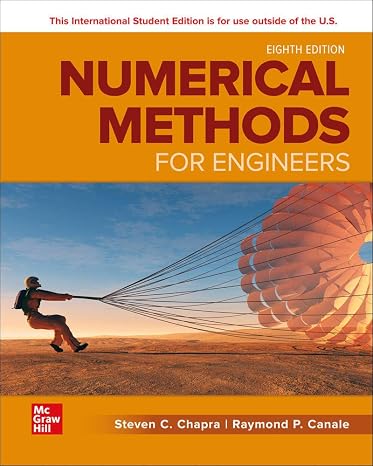
Numerical Methods for Engineers is a foundational undergraduate textbook authored by Steven C. Chapra (Tufts University) and Raymond P. Canale (University of Michigan), published by McGraw-Hill Education. Designed for engineering, science, and mathematics students, the text transitions learners away from tedious manual calculations toward practical, computer-based algorithms. It emphasizes real-world applications spanning civil, mechanical, electrical, and chemical engineering disciplines.
Core Curriculum & Topics
The textbook is systematically structured into key technical modules:
- Fundamentals & Error Analysis: Mathematical modeling, digital representation, roundoff/truncation errors, and Taylor series expansions.
- Equation Roots: Bracketing methods, open-ended methods, and polynomial root-finding.
- Linear Algebra: Systems of linear algebraic equations solved via Gauss elimination, LU decomposition, and Gauss-Seidel techniques.
- Optimization: One-dimensional, multi-dimensional, and constrained optimization problems.
- Curve Fitting: Least-squares regression, interpolation, and Fourier approximations.
- Calculus Operations: Numerical differentiation and integration, including Newton-Cotes formulas and adaptive quadrature.
- Differential Equations (ODEs & PDEs): Solutions for ordinary differential equations (Runge-Kutta methods, stiffness, boundary-value problems) and partial differential equations (finite-difference and finite-element methods).
Software & Computational Integration
To bridge theoretical concepts with modern engineering workflows, the book incorporates cross-platform computational tools and programming languages:
- MATLAB / Simulink
- Microsoft Excel and Mathcad
- Custom Code Implementation examples in C/C++, Fortran, and Visual Basic
Key Edition Highlight
- 8th Edition (McGraw-Hill, 2021): Features expanded digital companion materials, refined cubic spline formulations, enhanced Monte Carlo integration methods, and updated coverage of hyperbolic partial differential equations.